

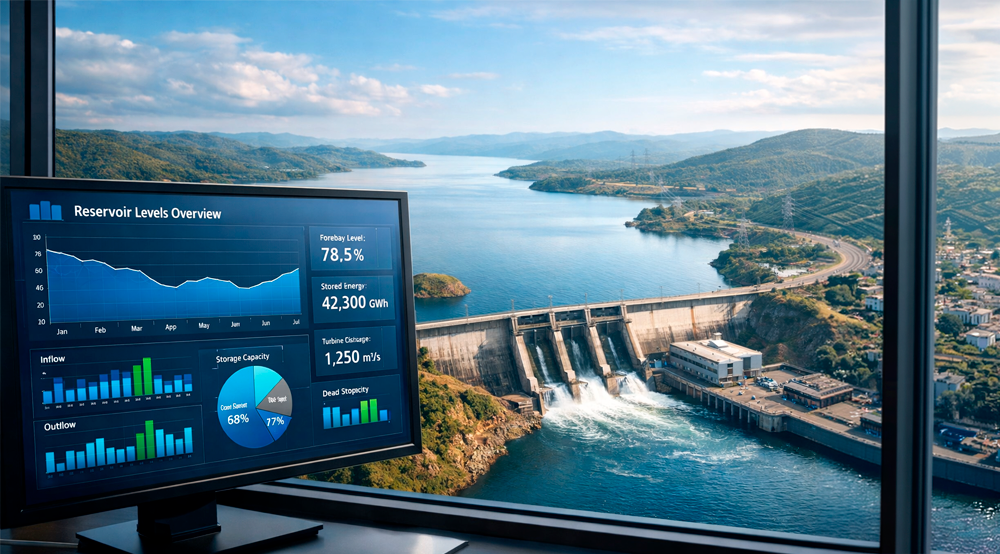
Hydroelectric reservoirs remain one of the clearest ways to understand how Brazil’s power system is performing. More than just a technical data point, they help reveal the broader context in which electricity is generated, managed, and monitored across the country.
When we talk about energy, we are also talking about water
In Brazil, understanding energy often means understanding water. That is because a large share of the country’s electricity generation is tied to hydropower plants and, as a result, to reservoir conditions.
What may seem like a distant or highly technical subject actually reflects something very concrete. Storage levels, water flows, and the amount of energy associated with stored water all help show how the system is behaving at a given moment. They do not explain everything on their own, but they are among the most important signals for understanding the power sector.
That is why this topic matters not only to operators and specialists, but also to companies that want a clearer view of the environment in which electricity is produced and managed in Brazil.
How this data is monitored
Reservoir monitoring is carried out by official institutions and systems that gather information on water levels, flow rates, and other hydraulic indicators that are essential for system operation.
The National Electric System Operator (ONS) monitors this data as part of its role in coordinating the operation of the power system. The National Water and Basic Sanitation Agency (ANA) organizes part of this information through public platforms such as the Reservoir Monitoring System (SAR), which makes historical and visual analysis easier.
In practice, this means there is a permanent monitoring structure in place. Some data is tracked close to real time, while other data is reviewed and consolidated to provide a more stable reading of the overall picture. For anyone looking at the sector from the outside, this has made reservoir monitoring far more accessible and understandable than it once was.
What to watch beyond the “water level”
When reservoir conditions enter the public conversation, attention often goes straight to a simple idea: full reservoirs versus low reservoirs. But the most useful reading goes beyond that.
One of the most important indicators is Stored Energy (EAR, from the Portuguese Energia Armazenada). In simple terms, it translates stored water into energy potential. In other words, it is not just about how much water is physically available, but about how much generating capability that water represents within the system.
Another important concept is the equivalent reservoir, which allows storage to be viewed in an aggregated way. Instead of analyzing each hydro plant individually, this measure groups multiple reservoirs into a broader system-wide picture, making it easier to understand the overall direction of the power sector.
This perspective shows that reservoirs are not just a snapshot of the moment. They are part of a broader reading of water availability, generation capacity, and how the electricity system is evolving.
A quick guide to the main terms
For anyone who does not work closely with this topic, some of the terminology can seem highly technical at first. But once the concepts are explained clearly, the data becomes much easier to follow.
| Term | What it means in practice |
| Forebay level | The water level on the reservoir side of the dam |
| Tailwater level | The water level below the dam, usually in the tailrace channel |
| Active storage | The portion of reservoir storage that can be used under normal operating conditions |
| Dead storage | The portion below the minimum operating level |
| Flood control storage | The portion intentionally kept available to help manage flood events |
| Inflow | The water flowing into the reservoir |
| Outflow | The water flowing out of the reservoir |
| Turbine discharge | The water that passes through turbines to generate electricity |
| Spill discharge | The water released without passing through turbines |
| Stored Energy (EAR) | The amount of power generation potential associated with stored water |
| Equivalent reservoir | A way of viewing multiple reservoirs as one combined system to simplify analysis |
Once these concepts are clear, the numbers stop feeling isolated. They become part of a broader and more understandable story about how electricity works in Brazil.
What SAR makes easier to understand
ANA’s Reservoir Monitoring System (SAR) plays an important role in making this topic more visible. The platform organizes public data on major reservoirs across the country using maps, tables, historical comparisons, and different ways to filter and view the information.
One of SAR’s main strengths is that it makes the data easier to read visually. In some modules, for example, users can see storage levels grouped into ranges and compare current conditions with previous years. That makes it easier to understand whether the current situation is more comfortable, more strained, or closer to the historical average.
For anyone who wants to follow the topic without diving too deeply into operational detail, this kind of visualization is especially helpful. It brings technical data closer to practical understanding.
The most important thing is not a single number, but the trend
Perhaps the most important point of all is this: looking at reservoirs does not mean focusing on one number in isolation. A single figure may draw attention, but it rarely explains the full picture on its own.
What truly matters is the trend. Is storage increasing or falling over time? How does the current level compare with previous periods? Is the system gaining flexibility or facing greater pressure? These are the questions that create a much richer understanding than a one-time snapshot ever could.
That is why reservoir monitoring matters. Not because every fluctuation should trigger concern, but because long-term patterns help build a more consistent and less superficial understanding of Brazil’s power sector.
Understanding reservoirs means understanding the power system more clearly
In the end, reservoirs help tell an important part of the story of electricity in Brazil. They show that behind the power delivered to businesses and consumers there is a complex system, continuously monitored and influenced by many different variables.
Understanding this data does not require advanced technical training, but it does require a willingness to look at the sector with a little more depth. That effort is worthwhile, because it leads to a clearer reading of the energy landscape and a better understanding of how the system behaves.
For Deal’s clients, this is the kind of monitoring that does not need to become a day-to-day concern. Part of our role is to follow the broader market environment, interpret the signals coming from the system, and turn that complexity into a clearer and more reliable picture. That allows clients to stay focused on their own business, knowing that the energy context around them is being closely watched.