
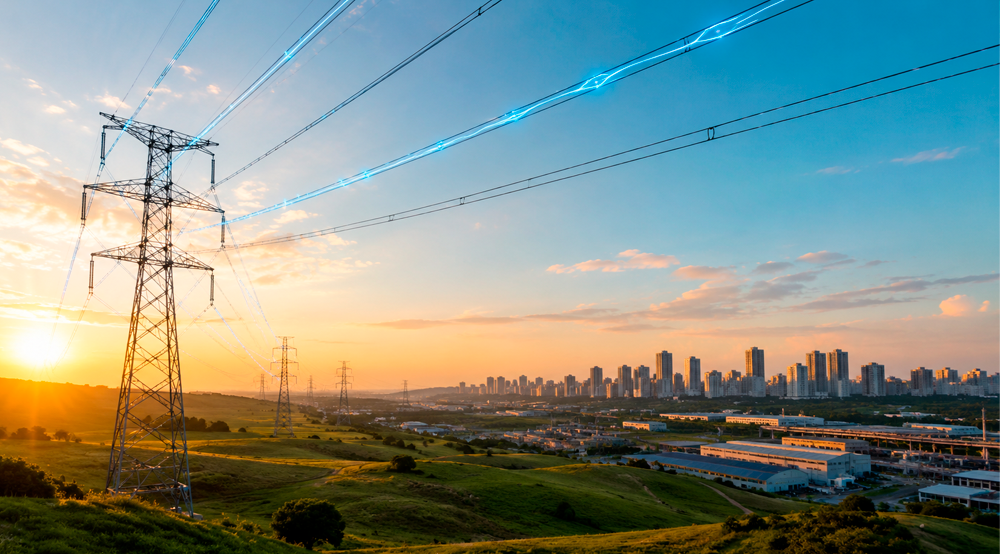
Between a power plant and the point of consumption lies an extensive infrastructure that connects regions, balances supply and demand, and delivers electricity to homes, businesses, and essential services.
Brazil has continued to expand its power generation capacity, particularly through the growth of solar and wind energy. Building new power plants, however, addresses only part of the challenge. For electricity to be effectively used, it must reach the places where it is needed.
This journey depends on the power transmission system, a network of high-voltage lines, substations, and equipment designed to carry large volumes of electricity across different regions of the country.
Without a grid capable of keeping pace with the expansion of both generation and consumption, electricity may be available but still face constraints that prevent it from being fully used. This is why power sector planning cannot focus solely on adding new generation capacity. Generation, transmission, distribution, and demand must all develop in a coordinated manner.
Electricity Must Travel Before It Can Be Used
Power plants are not always located near the largest consumption centers. Hydropower plants are built in areas with suitable geographic and hydrological conditions. Wind farms are concentrated in regions with stronger and more consistent winds, while solar projects are generally developed in locations with higher levels of solar radiation.
In many cases, these areas are hundreds or even thousands of kilometers away from the cities, industries, and businesses that will ultimately consume the electricity.
Power transmission bridges this distance. Electricity leaves generation sites through high-voltage lines and travels to substations located closer to consumption centers. From there, voltage levels are reduced, and the electricity enters the distribution grid for final delivery to consumers.
Transmission and distribution therefore perform different roles. Transmission carries large volumes of electricity across regions, while distribution supplies consumers within defined local areas.
Brazil’s National Electric Energy Agency, Aneel, divides the cost of electricity delivered to consumers into three main components: generation, transportation through transmission and distribution networks, and sector charges. The tariff structure itself shows that producing electricity is not enough. The infrastructure required to transport and distribute it must also be maintained. (gov.br)
How Brazil’s National Interconnected System Links the Country
Most of the electricity consumed in Brazil flows through the National Interconnected System, known as the SIN. This system brings together the generation and transmission infrastructure of the South, Southeast/Central-West, Northeast, and most of the North.
The network allows electricity produced in one region to be transferred to another according to changing generation and consumption conditions.
A region with strong hydropower output, for example, can help supply another area experiencing less favorable conditions. Likewise, wind power generated in Brazil’s Northeast can be transmitted to major consumption centers in other parts of the country.
This integration reduces dependence on local conditions and enables Brazil to make better use of its diverse energy resources. According to the National Electric System Operator, the ONS, interconnected networks allow electricity to be exchanged between regional subsystems, strengthen system security, and support more cost-efficient supply. (ons.org.br)
In this context, power transmission is more than a physical connection between power plants and consumers. It enables different generation sources, regions, and consumption patterns to operate as part of a single coordinated system.
Renewable Energy Makes Transmission Even More Important
The expansion of solar and wind power has made transmission infrastructure increasingly important to the operation of Brazil’s electricity system.
Many renewable energy projects are located far from the country’s largest demand centers. Brazil’s Northeast, for instance, offers highly favorable conditions for wind and solar generation, but local demand is not always sufficient to absorb all the electricity produced.
For that power to serve consumers in other regions, adequate transmission capacity must be available.
The challenge is also linked to the operating characteristics of renewable sources. Solar generation is concentrated during daylight hours and falls rapidly as evening approaches. Wind generation fluctuates according to wind conditions. Unlike some conventional power plants, neither source can be dispatched solely according to demand.
The system must therefore be able to respond to changes in generation and consumption in real time.
As Brazil’s electricity mix becomes more renewable and diverse, the country will need stronger grid integration, more accurate forecasting, greater operational flexibility, and additional solutions such as energy storage and demand response.
When Electricity Is Available but Cannot Be Fully Used
Installed generation capacity does not necessarily mean that all available electricity can be used at any given moment.
During certain periods, production may exceed demand or the amount of power that can be safely transported between regions. In these situations, the ONS may instruct some power plants to temporarily reduce their output.
This restriction is known as curtailment.
Curtailment can occur for several reasons. One is insufficient grid capacity to transport all the electricity being generated. Another is excess production during periods of lower demand. Technical constraints related to system stability and reliability can also lead to generation reductions.
According to the ONS, curtailment is a structural feature of systems with a high share of renewable energy because output changes over time and does not always coincide with peak demand. In such cases, reducing generation is a technical measure used to preserve the security of the National Interconnected System. (ons.org.br)
Expanding transmission capacity can reduce some of these constraints, but it cannot solve the challenge on its own. System balance also depends on consumption patterns, storage capacity, the flexibility of other generation sources, and overall grid conditions.
The central issue is that generation and consumption must be connected not only geographically, but also in time.
Transmission Infrastructure Must Keep Pace With Economic Growth
The electricity system must be planned to meet both current consumption and the new demand expected to emerge over the coming years.
The development of industrial facilities, data centers, hydrogen projects, electric mobility systems, and other large energy consumers can significantly change demand in specific regions.
To accommodate these projects, it is not enough for the country to have electricity under contract or sufficient generation capacity. The grid must also be capable of connecting and supplying these new loads without compromising system security.
Transmission planning must therefore address two questions at the same time: where new power plants will be built and where future consumption centers will be located.
Brazil’s Ten-Year Energy Expansion Plan 2035 estimates, under its reference scenario, approximately BRL 120 billion in transmission system investments through 2035. The plan links this expansion to the growth of renewable generation, stronger connections between regions, and the arrival of major new loads, including data centers and hydrogen production projects. (epe.gov.br)
These investments will help prepare Brazil’s power system for an increasingly electrified economy that depends on a continuous and reliable electricity supply.
Power Transmission Also Affects Electricity Costs
The infrastructure used to transport electricity carries construction, operation, maintenance, and modernization costs.
Transmission lines, substations, and other equipment must be built, monitored, maintained, and eventually replaced. Additional infrastructure is also required as generation and consumption continue to grow.
These costs form part of the economic structure of the electricity sector and are reflected in grid-use tariffs.
This does not mean that every new transmission line leads to a direct and proportional increase in consumers’ electricity bills. Costs are governed by regulatory rules and allocated according to different criteria.
Transmission nevertheless remains part of the final cost of electricity. For companies, understanding this structure is important because the price negotiated with an electricity supplier represents only one component of total energy expenditure.
A comprehensive assessment must also consider contracted demand, grid-use charges, sector charges, taxes, consumption patterns, and contractual conditions.
In the Free Energy Market, the Contract Changes — Not the Physical Route
The role of transmission also helps explain how electricity supply works in Brazil’s Free Energy Market.
When a company migrates to the free market, it can choose its supplier and negotiate terms such as price, volume, contract length, and energy source. This is a commercial and contractual change.
Physically, however, electricity continues to flow through the National Interconnected System and through the network operated by the local distribution company serving the consumer’s location.
There is no dedicated power line connecting the contracted power plant directly to the company. Electricity generated by different market participants is injected into the system, while consumption is metered and settled under the applicable market rules.
The local distribution company also remains responsible for the delivery infrastructure, grid quality, and support in the event of service interruptions.
The Free Energy Market expands consumer choice and creates new opportunities for energy management, but it continues to rely on the same physical infrastructure that supplies other consumers.
From the Power Plant to the Consumer
Expanding generation capacity is essential to meet rising demand and increase the share of renewable sources in Brazil’s electricity mix. New power plants alone, however, cannot guarantee that electricity will be available where and when it is needed.
Between generation and consumption lies a system that must transport large volumes of electricity, connect regions, and continuously respond to changes in supply and demand.
Power transmission plays a central role in this process.
It connects distant generation sources to consumption centers, enables the country to make better use of its energy resources, and supports the operation of homes, businesses, and essential services.
Generating electricity is the first step. To create economic and social value, that electricity must reach consumers safely, efficiently, and reliably.